
Local Surfer Takes On Plastic Pollution in Dakar’s Coastal Community
“I am trying to create awareness and impact people, especially my people-Senegalese people. There is a lot of us living on the coast, and we need to do even a small effort to clean our oceans, even if it is just refusing to use single-use plastic. My biggest goal is to just wake up and see another restaurant doing the same thing. I just want to get them [the community] inspired right now and tomorrow they can do even better than me- I have no doubt about that.”
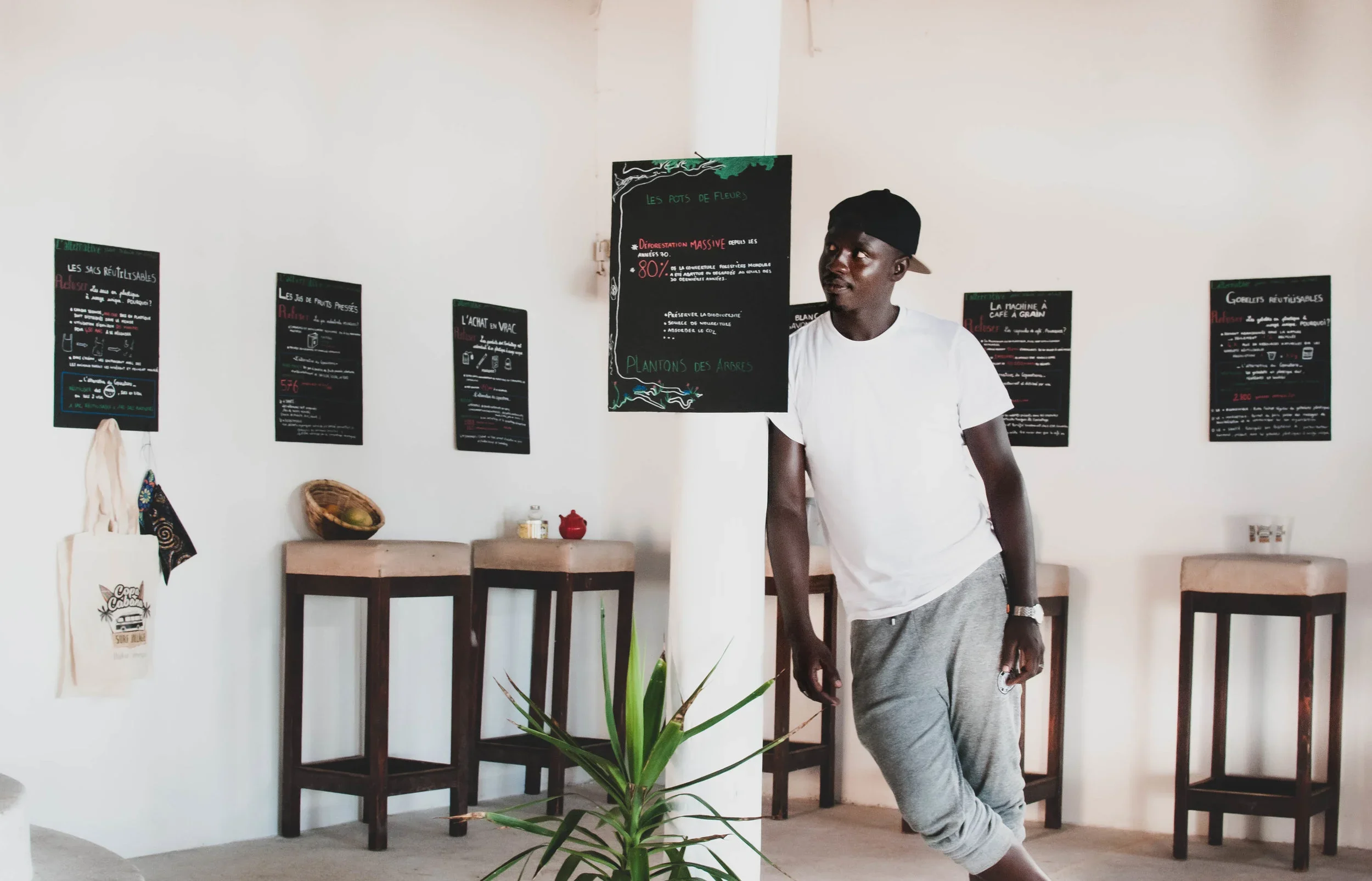
-Babacar Thiaw owner of Copacabana Restaurant and SeneSurf in front of his space’s gallery of pollution solutions
Virage Beach before Copacabana organized a community wide clean-up. Trash routes neglected to pick up the waste, causing it to overflow.
Not everyone fighting climate change does it in the spotlight. In every corner of the movement, everyday people are stepping in where their governments and the international community won't, with little of the media coverage or international praise. Senegal's coastal communities don't have the luxury of waiting for leaders to debate banning single-use plastics or capping how much waste pours into their oceans. So they're acting without them, fighting the crisis block by block, beach by beach, hoping their example speaks loud enough to finally move the people in power.
Virage Beach after the community-wide clean-up. Locals fear that the waste will continue to pile up if the government doesn’t take action to collect it.
Despite a population estimated at 17 to 18 million, Senegal remains one of the biggest ocean polluters in the world, ranking 21st globally despite its small size, with an estimated 250,000 tons of plastic waste dumped into the sea each year.
The effects are impossible to hide, especially in Dakar, the capital and the country's biggest source of pollution. Known for its coastline, warmth, and booming tourism industry, Dakar also bears the weight of government neglect, an overwhelmed waste management system, a rise in large commercial fishing vessels, and a dependence on single-use plastics that dominate the shelves of every boutique and supermarket.
The result is more than unsightly: plastics break down under the sub-Saharan sun into microplastics that can take up to a thousand years to decompose, poisoning what little marine life t foreign industrial trawlers haven't already swept up, and leaving less behind for local fishermen and markets. On land, overflowing trash cans and canals can be seen spilling into the streets, where goats and cows graze on the waste.
On August 3rd, Copacabana went Zero Waste. Refill station replaced water bottles, grain coffee replaced plastic Nescafe/Nespresso packets, and reusable napkins replaced paper — to name a few.
Many people are fed up while others are jaded, but few have gone as far as activists like Babacar Thiaw. I first met fellow surfer Babacar, owner of Copacabana Restaurant and SeneSurf School, five years ago in Dakar. Known to friends and regulars as Babs, he was already talking about securing a bright future for Senegal's coastal communities back in 2014. Beyond his warmth, always greeting you like an old friend, Babacar is known for his passion for community and environment. It's not rare to overhear him telling friends and new customers what needs to change: the polluted waters, the trash bins that overflow and never get picked up, or a surf community that needs to invest more in locals and the next generation before we're all surfing in hazmat suits. But he wasn't all talk. Babs has spent years doing more than his share, and recently achieved his biggest win yet: turning Copacabana into a zero-waste restaurant and surf school. The change didn't happen overnight, and it didn't come without sacrifice, but seeing the response, and the trend small businesses like his are setting, makes it worth it.
Years ago, Babacar's family fought to keep their beachfront land, where Copacabana now sits overlooking Virage Beach. When chain hotels tried to buy them out of land that had been theirs for generations, they held their ground.
"Big business, like chain hotels, doesn't care about the small businesses on the coast. They'll come, kick us out of our home, and do whatever they want with the land."
Babacar feels a responsibility to make Virage Beach an example for other local business owners on the importance of taking pride and responsibility for their land, because history has shown no one else will, a recurring disappointment he hopes to see change. Since then, he's kept his restaurant and surf school community-driven. Many Senegalese are reluctant to act when their government won't. A 2015 law banned plastic bags but was never enforced. Still, the situation has grown too urgent to ignore, and coastal communities bearing the brunt of polluted waters are increasingly forced to act themselves. Fishing and tourism, two of the region's largest industries, have suffered most: fishermen must travel farther from shore as wildlife flees polluted waters, and coastal tourism suffers as seas worsen during the rainy season. Babacar knows that awareness is key. He says:
“I am trying to create awareness and impact with people, especially my people-Senegalese people. There is a lot of us living on the coast, and we need to do even a small effort to clean our oceans- even if it is just refusing to use single use plastic. My biggest goal is to just wake up and see another restaurant doing the same thing. I just want to get them [the community] inspired right now and tomorrow they can do even better than me- I have no doubt about that.”
From organizing beach cleanups after giving surf lessons in plastic-ridden water, to buying large trash bins the city never collected, Babs finally knew he had to do something drastic. He converted Copacabana into a zero-waste space, tackling climate change on two fronts: cutting plastic pollution and educating the community on how to help. With refill stations (provided by bau eau bab), coffee grains replacing Nestlé packets, and a gallery of information on pollution and solutions, his impact is already spreading. He hopes that younger generations will see him as proof that you can protect your environment and still build something successful.
Copacabana plans to invest in color coded trashcans that will help with recycling and teach the importance of cleaning up after one-self. The restaurant is decorated with photos explaining how pollution affects coastal communities. Visitors are encouraged to a take free tour and participate in an information session to learn more about the concept.
“The future generation is really important to me, if I live more than 50 years from now, I will be very lucky. But most of the things we are doing now are for the future children; brothers and sisters. For me, I want them to take it like their own business because the environment is for all of us and if it is dirty, we cannot survive in it. They don’t need to be activists, but just take initiative.”
There's no simple explanation for why developing countries are hit hardest, climate change isn't one-dimensional. Underdeveloped waste management systems, weak infrastructure, government neglect both local and international, and a lack of public education on pollution's impact all play a role. It's a complicated picture: foreign industries sell plastic in bulk knowing full well that local waste systems can't handle disposal, while the long-term effects of dumping and littering remain largely unknown to the people living with them. In low-income countries, cheap sells, and single-use plastics are inexpensive, sold in small quantities for immediate need. But cheap doesn't mean sustainable.
Don't we have a moral responsibility to consider this before letting at-risk countries drown in our imported Coca-Cola bottles, single-use Nescafé packets, and thin plastic bags mass-produced in China? No matter where we live, we're all propping up big business by buying their products and ignoring the long-term cost to our environment. We've grown used to a throwaway culture, but in developed countries like the US, the consequences are hidden away in landfills, out of sight and out of mind. Not every country has that privilege.
The fishing industry is said to provide 70% of all animal protein consumed in the country. Dead fish lined beaches of the North Coast in mid-September after heavy rains polluted coastline having a deadly impact on the marine life close to shore. As fish move further from the coast, local fishers must compete with foreign industrial trawlers—often operating illegally.
Rwanda and Kenya have led the way in enforcing anti-pollution laws, and Morocco banned the thin plastic bags locally known as "Moroccan flowers," with the government following through on enforcement and seeing real change. Senegal has claimed it will follow suit, proposing stricter single-use plastic bans in the coming year. But promises aren't enough, which is why activists are calling on the international community to step in. These problems are too big for small countries to tackle alone. Many of the worst offenders producing single-use goods are foreign industries that pay no taxes on what they sell and hold outsized market power, making it even harder for the government to fund affordable alternatives or build proper waste infrastructure. Local companies contribute too, like water bottle producer Kirene, whose bottles show up everywhere: flattened on the streets, clogging canals, floating in the channel at local surf breaks. Kirene dominates the water market, and while it now offers refillable jugs, it hasn't scaled back single-use production. Clean water is non-negotiable, and Senegal, no stranger to water cuts, finds it an easy, lucrative sell. But the long-term cost may outweigh the convenience. Water pollution becomes cyclical: the same plastic clogging canals and leaching toxins into water sources, into your home, your food, is the plastic your clean water came packaged in.
It's exciting to see the action already happening at the local level in Dakar, but it makes one thing clear: the bigger players need to step up. When most of the population lives on less than $2 a day and immediate needs are also basic needs, it's hard to ask people to prioritize the environment. Still, the effects of climate change are no longer easy to ignore, and eco-friendly solutions have become essential to the community's well-being. From planting trees to eco-friendly startups and beach and street cleanups, more everyday people are stepping up as leaders and taking matters into their own hands.
Support your local communities and invest in them, as our future depends on it.
Want to support local businesses that are tackling the climate crisis in Senegal? Check out and support these innovates…
Copacabana/SeneSurf : Restaurant and Surf School at Virage Beach
ZERODECHET : Waste Reduction Start-up based in Dakar
KeurDesMamelles : Eco-friendly Airbnb & Yoga studio
Mamelles Beach : Chez Max zero plastic restaurant featuring art up-cycled from trash
bau eau bab : Reusable and filtered water systems delivered to your house or business
Take Off Ngor : re-purposed surfboards for the local youth ( donate an old board!)
recuplast : recycle your plastic waste at collection points … and get money per KG!
Know someone who is fighting the climate crisis? Send me a message and I will add them to this list!